Why Ruth Brayshaw Mosaic Layout by Hand
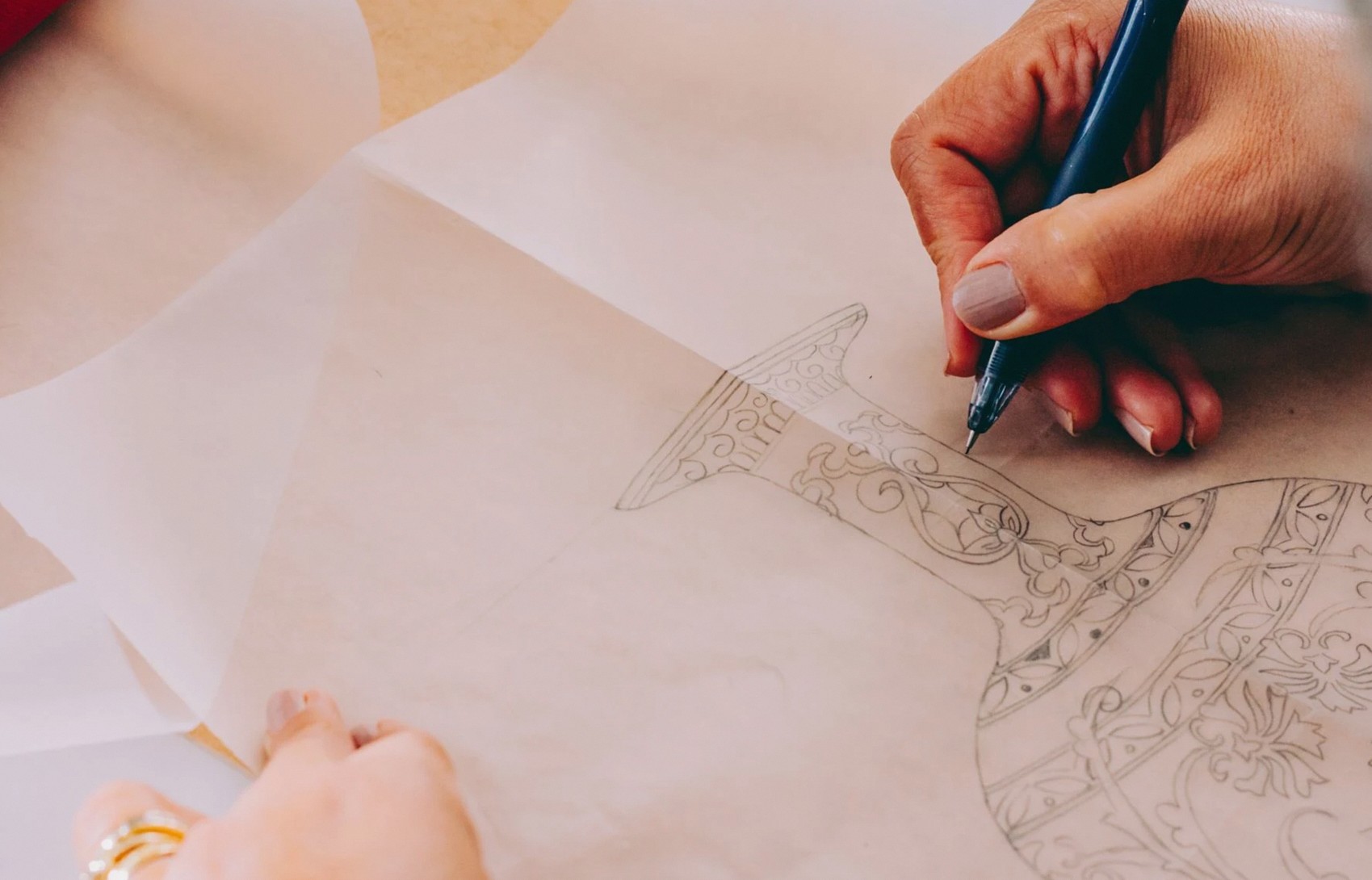
Every project at Pure Mosaic Hub starts with a hand drawing. Not a sketch, a scaled drawing on graph paper with the tile dimensions worked out in pencil. Ruth has been doing this since the studio opened in 2017, and she has no plans to change it.
What the hand drawing catches
The most common problem in mosaic layout is what happens at the edges. A geometric pattern that tiles perfectly in the center of a room often produces awkward slivers at the walls, or a cut that lands in the worst possible place, like the middle of a doorway threshold. Software can flag this, but it flags it after you have already committed to a layout direction.
Drawing by hand forces you to work through the edge conditions before anything else. You start at the center, work outward, and when you hit the wall you see immediately whether the cut is acceptable. If it is not, you shift the grid. On paper, that shift takes 30 seconds. In a tiled room, it takes a grinder and a new tile.
The scale question
Digital tools render tile layouts at any scale, which sounds like an advantage. The problem is that a pattern that looks balanced on a screen at 1:20 scale can look very different at 1:1 on a wall. Small tiles in a complex pattern read differently at human scale than they do on a monitor.
Ruth draws at 1:10 for most residential projects, which is large enough to see the visual weight of the pattern without being unwieldy. At that scale, a 2-inch tile is drawn at 5mm, which is small but legible. The drawing goes on the wall of the studio for a day before it goes to the client, so she can look at it from a distance and check the rhythm of the pattern.
What happens after the drawing
Once the hand drawing is approved internally, it gets scanned and traced in vector software for the final client presentation. The digital version is cleaner and easier to annotate with tile codes and grout specifications. But the design decisions have already been made on paper.
The sample board goes out alongside the digital drawing. Clients get both: the scaled layout showing the pattern, and the physical board showing the actual materials in their actual colors. The combination reduces revision rounds significantly.
The hand-drawing step adds time to the front end of every project. Ruth thinks it saves more time than it costs, and the finished work tends to agree.